Showing posts with label Indigo. Show all posts

Saturday, August 31, 2019

Sunflower & Indigo happiness

I wish all handwork teachers lots of joy and patience for the upcoming school year.  I hope to post a lot more this year and take you through my school year.  Im very happy to say I will be teaching Grade 1/2 combined, Grade 3, Grade 4, Grade 5, Grade 6/7 (double period) and Grade 8 (double period). 
These are the sunflowers that Grade 1 planted in the classroom last year and I planted outdoors at the beginning of the summer.  They will gather under there for the first class and see the beauty of their efforts.  We will then gather some plants from the dye garden (right behind this) and start some sun dye jars with string for Grade 4 to embroider with.  Grade 6/7 will be helping me with the indigo vat I want to start.  Exciting times with the dye garden.

Thursday, August 6, 2015

Greens and all the Rainbow Glory

Natural Rainbow Glory

Left to right strips: Goldenrod/Indigo(4), Indigo(4), Indigo/Cochineal(3), Logwood(1), Cochineal(2), Bloodroot(2), BlackWalnut(3),OsageOrange(1), Marigold(1), Goldenrod(2)
I always have extra yarns around when I simmer up this many colors and dye bits and pieces.  I have finally knit up a little swatch to show them off.  


Greens are everywhere in nature especially in summer but it is really hard to achieve in natural dyeing without over dyeing (combining two colors).  Indigo and goldenrod have to be my favorite color combinations - they greens I are given are spectacular and I like to leave the finished color all around the house so I can just look at it as I pass by.    


I was dyeing two different yarns - Bartlett and Brown Sheep - both produce wonderful greens but spectacularly different even pulled from the same pot at the same time.

Here are the finished custom naturally dyed yarns for Green Meadow Waldorf School.  You too could have spectacular color just drop me an email by stoping by my Etsy shop, I dye yarns, loose wool and some natural cloth.
Brown Sheep Worsted: OnionSkins, Marigold, BlackWalnut, Logwood, Blackwalnut/Logwood, Cochineal/Indigo, Bloodroot, Cochineal 2ndRow: Goldenrod, Mint (Iron), Indigo/goldenrod, Indigo, Indigo/Cochineal


Bartlette Yarns:  OnionSkins, Goldenrod, Goldenrod/Indigo, Indigo, 2nd row:Bloodroot, BlackWalnut, Cochineal/Indigo, Cochineal


Used the Indigo pot to dye some cloths for the obligatory Family Beach shot - I think its going to be great this year.

Friday, October 31, 2014

My Own Natural Japanese Indigo


Natural Japanese Indigo from my garden.

I was hopeful when the seeds showed up this past April.   They were lovingly planted and hope sprung up as seedlings.  Successfully planted in the garden the plants grew nicely.  The 7 plants I planted branched out and created a nice clump of leaves and small flowers, see the weld in front too.

I was gone most of the summer and I never used the leaves in the 'first' available harvest.
I clipped quite a few leaves (after flowering) and fermented them in a mason jar for more than a week.  Don't forget to hold our nose when you open it up Outside!  The smell is overwelming.  I heated up this to 140 degrees for a couple of hours.  I then sifted out the leafs and squeezed out all the indigo I could.  Re soaking the bundle and squeezing some more. 


 Then you pour the liquid back and forth for about 5 minutes.  I never got the froth to be blue - I think I picked the leaves too late in the season but it was still was worth getting the color I got.  Try to keep the vat warm/hot.  I then sprinkled spectra light - or - Rite color remover (found amongst the dye rack) = about a Tablespoon or so, then let it rest at 120 degrees for another couple of hours.  I soaked the merino wool in very warm water, then added it to the dye vat.


 Unlike indigo crystals, you need to leave your fiber in the indigo vat for 20-30 minutes each dip.  The liquid is a beautiful brown yellow and then when you pull out the fiber its such a thrill to watch it turn from yellow to green to blue. YAY. 


I really love the color that came out was a wonderful sea foam blue.  I have a second pot on the stove right now and I will be seeing if I can get a stronger blue to spin up a darker skein.


 I also have the left over flowers hanging in the kitchen.  They were pollenated and now since it turned too cold to seed outside, I cut them and brought them inside.  After a day or so I will place a bag over them to catch the tiny black seeds when they start to fall.  Hopefully.


This Fall has just been gorgeous this year - really enjoying the warmer weather and Fall colors.


Sunday, July 20, 2014

Natural Dye Chart


I have been doing a  lot of Natural Dyeing this summer already.  These are some samples I kept.  If you have any questions let me know.  Different wools (breeds and there for yarns) soak up the dye differently.


Monday, September 16, 2013

Plant Dyed Yarn


Once again I had the pleasure of dyeing the yarn for the children at Green Meadows Waldorf School.  I was given the yarn early in the summer and finished it just in time.  The colors that resulted from coaxing the dye pots all summer long were exciting, mysterious and hard all rolled into one.  Among the dye stuffs I used were, Onion Skins, Cochineal, Indigo, Black Walnut, Cutch, Wolfe Lichen &  Goldenrod.  If you have a question about the color combinations I will do my best to remember.  I used Cream of Tartar and Alum as the fixative.  All were warm/hot baths except for the cutch which was cold (the tan color).


There were two types of yarn that I dyed.  
Brown Sheep - Lambs Pride Single ply worsted (on the left) 
 &
  BartlettYarn - Fisherman 2-ply yarn (on the right).
Both are in unbleached 4oz skiens.


Now, I have been working with Indigo for many years now.  Natural, cakes, freeze dried, so I don't call myself a novice anymore.  Dyeing with Indigo is always tricky.  Sometimes its just not ment for certain yarns, like the Bartlett fisherman yarn.  The wonderful natural oils that they leave in there just prevent the indigo from biting.  I even presoaked and scoured the yarn with no avail.  It ran clear but when it dried it still crocked off, when from the same pot I pulled the Brown sheep yarn with no crocking.


 Bartlettyarn


 Brown Sheep


Monday, January 14, 2013

Summer Dyeing

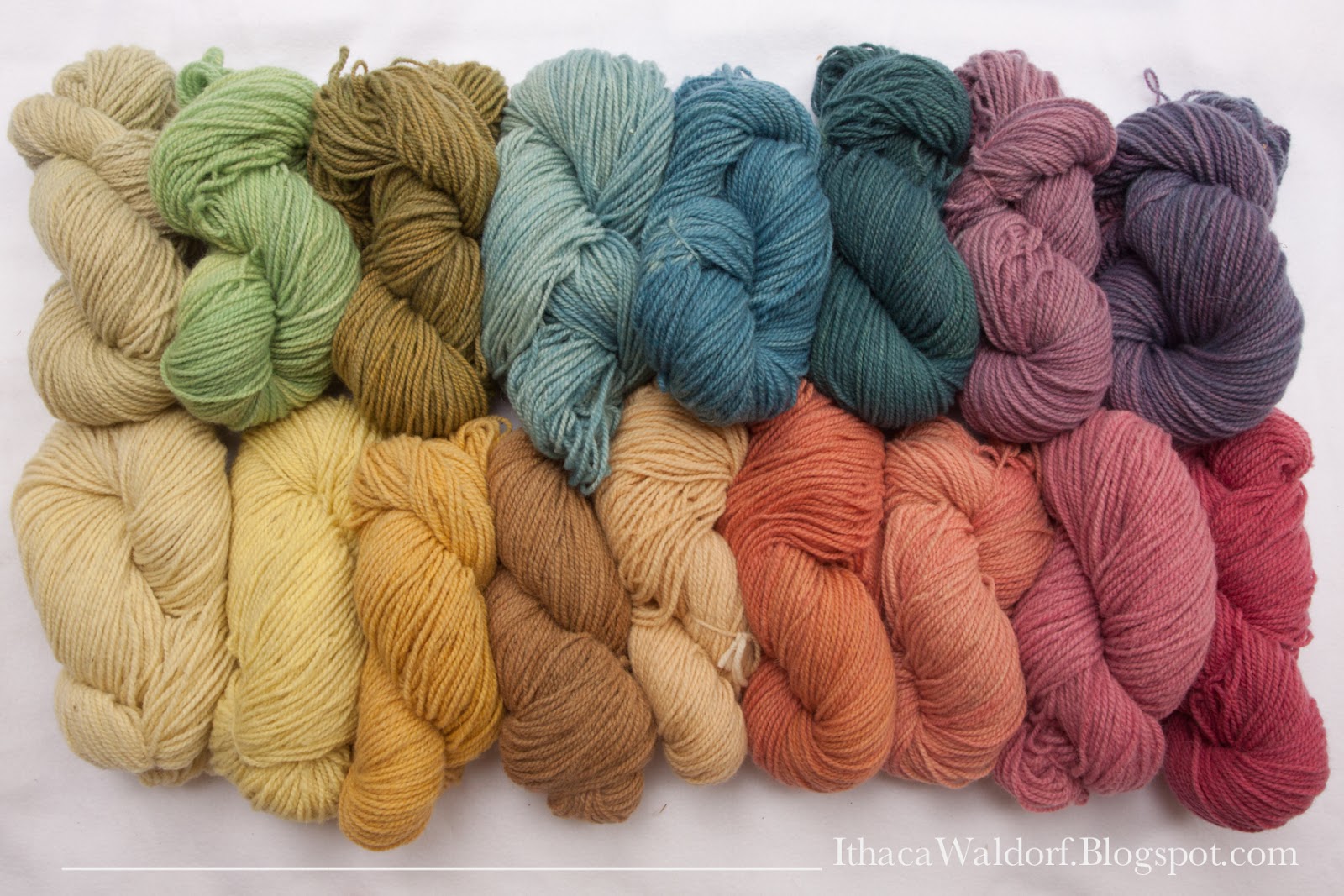
I was commissioned to plant dye some yarn for The Green Meadow Waldorf School this summer.  Chris is the co-director of Fiber Craft Studio and one of my teachers for my Waldorf training.  We emailed back and forth about the colors the school needed, but I was given artistic license to trust the colors that came out of the dye pots.  


The strength of color was at its best, left over dye pots were used to dye some lighter shades, but most were left to soak in the pot for a longer time or multiple dips to acquire the darker shade. So many people associate pale colors with plant dyeing, or colors that fade.  If done properly colors will not fade (as I do with Cream of Tartar & Alum) or with use of strong pots (if that is your color taste), you will be left with some amazing colors to play with.


 I obtained the different yellows thru willow tree tips (a creamy yellow) Osage Orange and also, onion skins.  The pinks and the darker pink/red was strictly cochineal mixed with cream of tartar (that brings out the reds).  Purples are made with Indigo over cochineal and then the green are Indigo over the different yellows a mentioned above.  Browns were made by a cold bath of black walnuts as well as a hot bath of the same (yes, you get different colors hot vs. cold).  The sheet of paper I used to figure out the colors and over dyeing looked like a tennis match tournament and I was surprise when it was all done correctly.


All in all I was please and so were the handwork teachers, lots of love & long hours but worth it in the end.

Rainbow of Plant Dyed Yarns - ©Ithaca Waldorf Handworks & More