Showing posts with label black Walnut. Show all posts

Thursday, August 6, 2015

Greens and all the Rainbow Glory

Natural Rainbow Glory

Left to right strips: Goldenrod/Indigo(4), Indigo(4), Indigo/Cochineal(3), Logwood(1), Cochineal(2), Bloodroot(2), BlackWalnut(3),OsageOrange(1), Marigold(1), Goldenrod(2)
I always have extra yarns around when I simmer up this many colors and dye bits and pieces.  I have finally knit up a little swatch to show them off.  


Greens are everywhere in nature especially in summer but it is really hard to achieve in natural dyeing without over dyeing (combining two colors).  Indigo and goldenrod have to be my favorite color combinations - they greens I are given are spectacular and I like to leave the finished color all around the house so I can just look at it as I pass by.    


I was dyeing two different yarns - Bartlett and Brown Sheep - both produce wonderful greens but spectacularly different even pulled from the same pot at the same time.

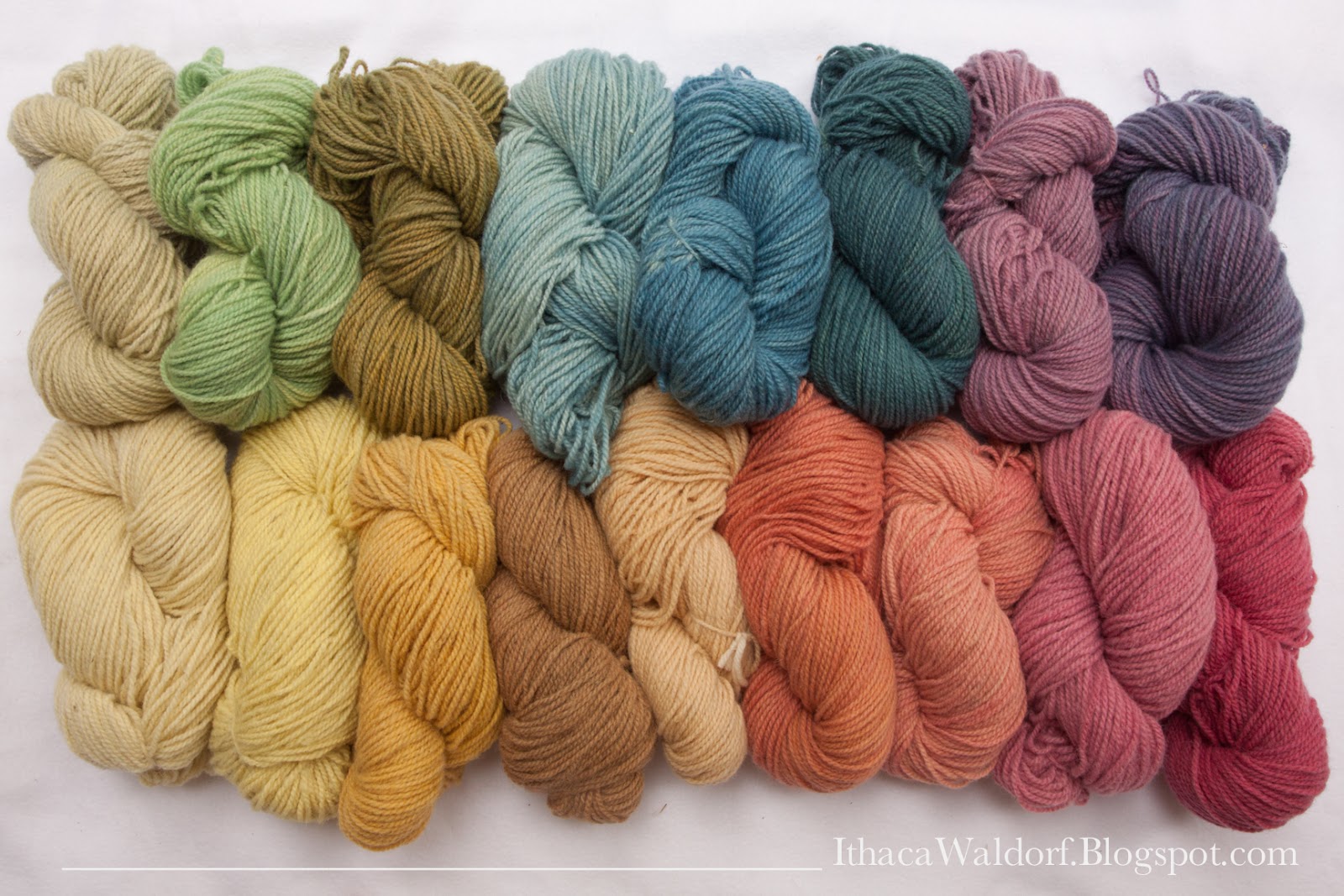
Here are the finished custom naturally dyed yarns for Green Meadow Waldorf School.  You too could have spectacular color just drop me an email by stoping by my Etsy shop, I dye yarns, loose wool and some natural cloth.
Brown Sheep Worsted: OnionSkins, Marigold, BlackWalnut, Logwood, Blackwalnut/Logwood, Cochineal/Indigo, Bloodroot, Cochineal 2ndRow: Goldenrod, Mint (Iron), Indigo/goldenrod, Indigo, Indigo/Cochineal


Bartlette Yarns:  OnionSkins, Goldenrod, Goldenrod/Indigo, Indigo, 2nd row:Bloodroot, BlackWalnut, Cochineal/Indigo, Cochineal


Used the Indigo pot to dye some cloths for the obligatory Family Beach shot - I think its going to be great this year.

Thursday, December 19, 2013

Making your own Black Walnut Ink

Easy to make Black Walnut, Brown Ink.
 In the Fall, collect black walnuts from the ground, make sure they are green with brown spots (more the better).  Put them in a plastic bag and let them rot.  The green ones will turn black over a few days or weeks, but be careful the squirrels dont run off with them - my first batch they did!  You do not have to remove the nuts from the hulls - just plop them in a pot as is (bugs and all - eew).  Put them in a pot of water enough water to cover the nuts + a bit more.   Simmer away for a few hours.  If the hulls were not broken apart from ripening in the plastic bag - you can always poke them and tear at them with a knife/fork as they simmer to let all the good brown out of them.  You can check the strength of the ink if you have a white stove top or a paintbrush and paper too.  I think this simmered for three hours - I added more water as to not let it get too low but still only wanting 3/4ths of a Mason jar full.


 I strained out the large pieces of walnut hull/nuts out with a large metal spoon with holes.  I then chucked the spent debris over the garden fence.  Using cotton bags and a blue canning funnel I poured the remaining liquid in to strain...


 Then this happened - too many large pieces remained and over flowed the funnel and out thru the sides.  I quickly changed the cotton cloth to mesh and it worked out much better.  I also had to move the "gunk"' around with a fork so it would go thru the mesh.  
Thats it, easy, messy but easy.  *Guess I should have done this outside*

Store in a mason jar with a lid.  It has been several months now and I see no mold.  Gum Arabic can be added to improve the flow of the color but I like it the way it turned out without it.  If you like the color - great - if not simmer just the liquid down a bit more to get a stronger color.

 Currently I am knitting a large cowl scarf with my latest hand spun plant dyed yarn - I'll show you when I'm finished.


Monday, September 16, 2013

Plant Dyed Yarn


Once again I had the pleasure of dyeing the yarn for the children at Green Meadows Waldorf School.  I was given the yarn early in the summer and finished it just in time.  The colors that resulted from coaxing the dye pots all summer long were exciting, mysterious and hard all rolled into one.  Among the dye stuffs I used were, Onion Skins, Cochineal, Indigo, Black Walnut, Cutch, Wolfe Lichen &  Goldenrod.  If you have a question about the color combinations I will do my best to remember.  I used Cream of Tartar and Alum as the fixative.  All were warm/hot baths except for the cutch which was cold (the tan color).


There were two types of yarn that I dyed.  
Brown Sheep - Lambs Pride Single ply worsted (on the left) 
 &
  BartlettYarn - Fisherman 2-ply yarn (on the right).
Both are in unbleached 4oz skiens.


Now, I have been working with Indigo for many years now.  Natural, cakes, freeze dried, so I don't call myself a novice anymore.  Dyeing with Indigo is always tricky.  Sometimes its just not ment for certain yarns, like the Bartlett fisherman yarn.  The wonderful natural oils that they leave in there just prevent the indigo from biting.  I even presoaked and scoured the yarn with no avail.  It ran clear but when it dried it still crocked off, when from the same pot I pulled the Brown sheep yarn with no crocking.


 Bartlettyarn


 Brown Sheep


Tuesday, September 10, 2013

Unveiling of Sun Jars

 This is what the jars looked like after sitting all night.  


 I guess I could have waited another day to unwrap it, but the weather was not cooperating and was supposed to be rainy for a few days.  Plus I couldn't wait!


The string does act as a resist - when you wrap the items as dry cloth/wool.  I think I might wrap with thicker string and more of it next time.


The darker spots are black walnut chunks, the orange comes from the direct contact of the fresh coreopsis flowers - as well as the yellow from goldenrod.


 I plan on sewing the long edges 1/3 together on both sides (a space unsown in the middle of the "tube") to make shawl/bolero type cover.