Showing posts with label onion skin. Show all posts

Thursday, August 6, 2015

Greens and all the Rainbow Glory

Natural Rainbow Glory

Left to right strips: Goldenrod/Indigo(4), Indigo(4), Indigo/Cochineal(3), Logwood(1), Cochineal(2), Bloodroot(2), BlackWalnut(3),OsageOrange(1), Marigold(1), Goldenrod(2)
I always have extra yarns around when I simmer up this many colors and dye bits and pieces.  I have finally knit up a little swatch to show them off.  


Greens are everywhere in nature especially in summer but it is really hard to achieve in natural dyeing without over dyeing (combining two colors).  Indigo and goldenrod have to be my favorite color combinations - they greens I are given are spectacular and I like to leave the finished color all around the house so I can just look at it as I pass by.    


I was dyeing two different yarns - Bartlett and Brown Sheep - both produce wonderful greens but spectacularly different even pulled from the same pot at the same time.

Here are the finished custom naturally dyed yarns for Green Meadow Waldorf School.  You too could have spectacular color just drop me an email by stoping by my Etsy shop, I dye yarns, loose wool and some natural cloth.
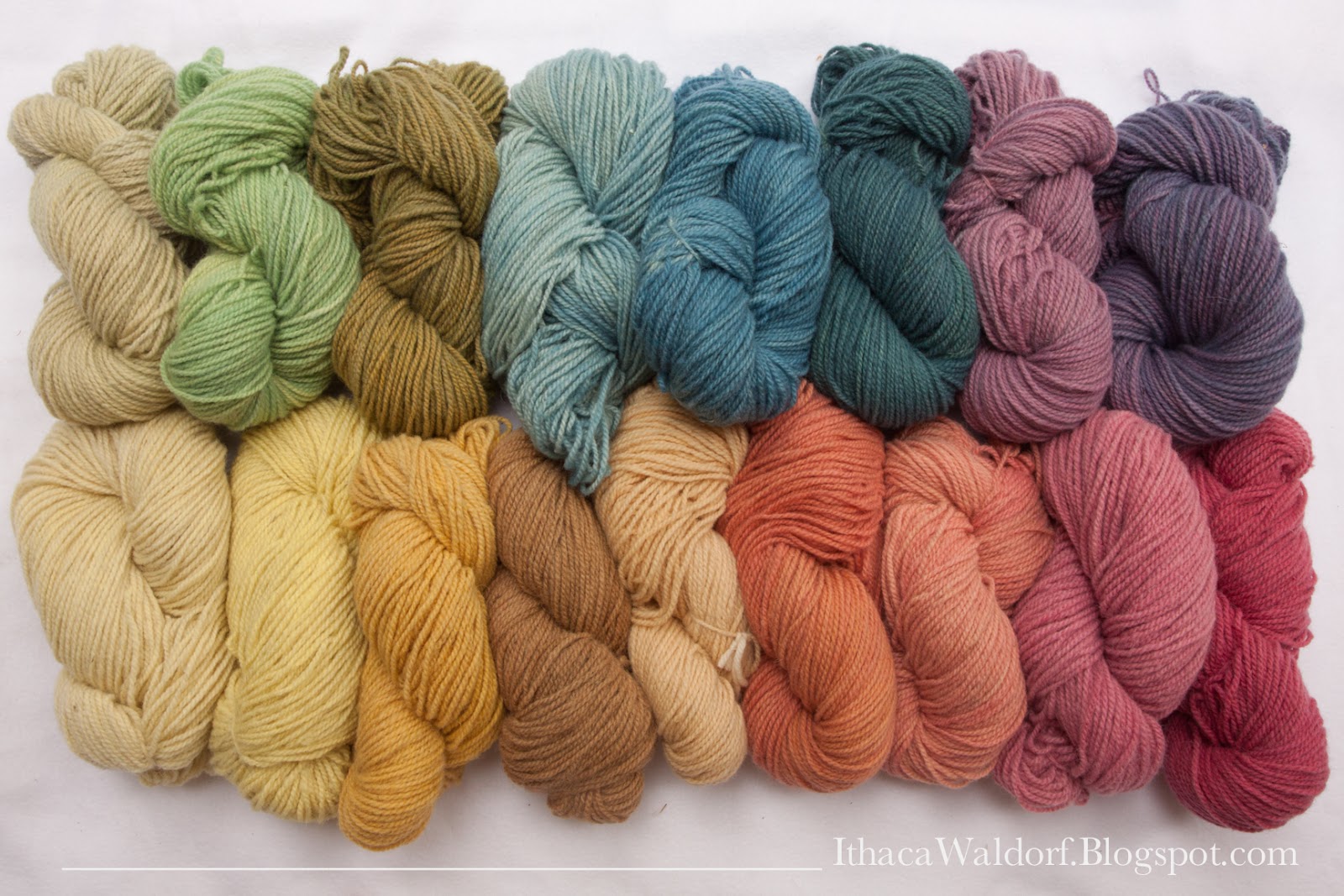
Brown Sheep Worsted: OnionSkins, Marigold, BlackWalnut, Logwood, Blackwalnut/Logwood, Cochineal/Indigo, Bloodroot, Cochineal 2ndRow: Goldenrod, Mint (Iron), Indigo/goldenrod, Indigo, Indigo/Cochineal


Bartlette Yarns:  OnionSkins, Goldenrod, Goldenrod/Indigo, Indigo, 2nd row:Bloodroot, BlackWalnut, Cochineal/Indigo, Cochineal


Used the Indigo pot to dye some cloths for the obligatory Family Beach shot - I think its going to be great this year.

Monday, May 4, 2015

Plant Dyeing Workshop


I have finally taught a 'proper' workshop on plant dyeing.  I have had many dyeing sessions with friend, and at work, but this one was the first attempt at an organized event.  Thank you Craftstitute for creating space here in Ithaca where artists can come and have a space to teach a class.   I think it went off very well and I hope my - newly addicted to color friends - agree.


We started off by putting plastic labels on the skeins, then pre-soaking the fibers in water.  I had already mordanted the skeins prior to class in Alum & Cream of Tartar.  After adding the dye stuff which was - Sage brush ( I collected some branches when I went out west a few years ago), dried Marigold flower heads, Red Onion skins, Madder and then a lichen I had soaking in an ammonia bath for a month - after about 45 minutes of hot soaking we then strained the bath thru mesh and cheesecloth.


The marigold turned out to be a really strong yellow and everybody loved it.


The red onion skin didn't turn out a greenish as it had in the past.  Its a wonder to get get color from nature and its always a surprise.


The madder had been soaking in my kitchen for days and the red (on the orange side) that we got was very impressive.


Stunning results - thank you nature.

Monday, September 16, 2013

Plant Dyed Yarn


Once again I had the pleasure of dyeing the yarn for the children at Green Meadows Waldorf School.  I was given the yarn early in the summer and finished it just in time.  The colors that resulted from coaxing the dye pots all summer long were exciting, mysterious and hard all rolled into one.  Among the dye stuffs I used were, Onion Skins, Cochineal, Indigo, Black Walnut, Cutch, Wolfe Lichen &  Goldenrod.  If you have a question about the color combinations I will do my best to remember.  I used Cream of Tartar and Alum as the fixative.  All were warm/hot baths except for the cutch which was cold (the tan color).


There were two types of yarn that I dyed.  
Brown Sheep - Lambs Pride Single ply worsted (on the left) 
 &
  BartlettYarn - Fisherman 2-ply yarn (on the right).
Both are in unbleached 4oz skiens.


Now, I have been working with Indigo for many years now.  Natural, cakes, freeze dried, so I don't call myself a novice anymore.  Dyeing with Indigo is always tricky.  Sometimes its just not ment for certain yarns, like the Bartlett fisherman yarn.  The wonderful natural oils that they leave in there just prevent the indigo from biting.  I even presoaked and scoured the yarn with no avail.  It ran clear but when it dried it still crocked off, when from the same pot I pulled the Brown sheep yarn with no crocking.


 Bartlettyarn


 Brown Sheep


Friday, April 8, 2011

Onion Skin Egg Dyeing - Tutorial


Onion Skin Dye

I have one pot of yellow onion skins and the photo below is the pot of red/purple onion skins. Now... you can get a multitude of colors from both skins ( I recommend keeping them in separate pots) depending on temp and variety of onion and if you use Alum or Ammonia/vinegar before or after. Its just one of the most wonderful dyes there is and you do not have to pre-mordant to keep the color light safe. I have been told that you can get some green dye with the purple skins but I have yet to see it myself (I have seen others) the yellow skins give a rich lushes yellow/orange.


1. Wet the skins for a minute or two then place a few skins in your palm.
2. Place greens - small leafs, tips of ferns, blades of grass.
3. Place a raw egg on those greens
4. Place more greens on the others side of the egg (facing you)
5. Fold up from the sides the rest of the onion skins (also may need to place more wet skins if you do not have enough) on top
6. Wrap the whole package with string or rubber bands.
The tighter you wrap the more detail the resist of the "greens" will ghost onto the egg. I say ghost because some places you will get sharp detail but mostly it will look blurred.


Like I said, I recommend keeping two pots for the different colored skins (by the way, white onion skins do not release any color). Here we can see the yellow onion skins on the left and the darker red skins on the right (these have already been boiled).


Place them in the cool to warm pot of water (do not place cold eggs in hot to boiling water as they will crack) Place as many extra skins in the pot that you have - handfuls are good. I collect skins all year long for this event. Bring to a boil - which might take some time as there is a lot of stuff in the pot) then boil the eggs for 20 minutes. Turn off the heat. Now comes the hard part... wait...at least a half an hour or a few is better. Take out the eggs and unwrap.


The darker eggs are from the red onion skins. Here is a detail of a fern on the egg being unwrapped. It was a good placement and wrapped snugly.


I did this pot of dye with grade 4/5 today and then I just couldn't throw away the pot of color so I took it home and you can see the eggs on the right are done with fresh skins and the ones on the left are the "second" time around. Still delightful and full of color but the darker ones have a larger range of reds/orange/yellow.


Enjoy, I highly recommend it. Learn from me and ware gloves (I currently have yellow fingers)
The photo at the very top is yellow skins on velour, red skins on velour & silk done with yellow skins. Rich!