Showing posts with label plant dyes. Show all posts

Thursday, August 6, 2015

Greens and all the Rainbow Glory

Natural Rainbow Glory

Left to right strips: Goldenrod/Indigo(4), Indigo(4), Indigo/Cochineal(3), Logwood(1), Cochineal(2), Bloodroot(2), BlackWalnut(3),OsageOrange(1), Marigold(1), Goldenrod(2)
I always have extra yarns around when I simmer up this many colors and dye bits and pieces.  I have finally knit up a little swatch to show them off.  


Greens are everywhere in nature especially in summer but it is really hard to achieve in natural dyeing without over dyeing (combining two colors).  Indigo and goldenrod have to be my favorite color combinations - they greens I are given are spectacular and I like to leave the finished color all around the house so I can just look at it as I pass by.    


I was dyeing two different yarns - Bartlett and Brown Sheep - both produce wonderful greens but spectacularly different even pulled from the same pot at the same time.

Here are the finished custom naturally dyed yarns for Green Meadow Waldorf School.  You too could have spectacular color just drop me an email by stoping by my Etsy shop, I dye yarns, loose wool and some natural cloth.
Brown Sheep Worsted: OnionSkins, Marigold, BlackWalnut, Logwood, Blackwalnut/Logwood, Cochineal/Indigo, Bloodroot, Cochineal 2ndRow: Goldenrod, Mint (Iron), Indigo/goldenrod, Indigo, Indigo/Cochineal


Bartlette Yarns:  OnionSkins, Goldenrod, Goldenrod/Indigo, Indigo, 2nd row:Bloodroot, BlackWalnut, Cochineal/Indigo, Cochineal


Used the Indigo pot to dye some cloths for the obligatory Family Beach shot - I think its going to be great this year.

Monday, July 27, 2015

Adventures in natural dyeing


Once again I am dyeing the wool yarn for Green Meadow Waldorf School  This always gets me excited because I collect a lot of dye stuff for pots and couldn't possible use it all myself.  Willow tree tips, onions skins, marigolds, bloodroot, goldenrod, coreopsis, mint, black walnuts, lichen and mushrooms galore.  The list is endless and I always have a pot on the stove cooking or "waiting" in the corner.   For these yarns I always use alum and cream of tartar for the mordant and at most I might use a bit of washing soda to change the Ph of the water.  This year I used the stream to rinse most of the yarns to cut back on using the electricity for the pump - its amazing how much water just flows by the house - I need to use that more often.

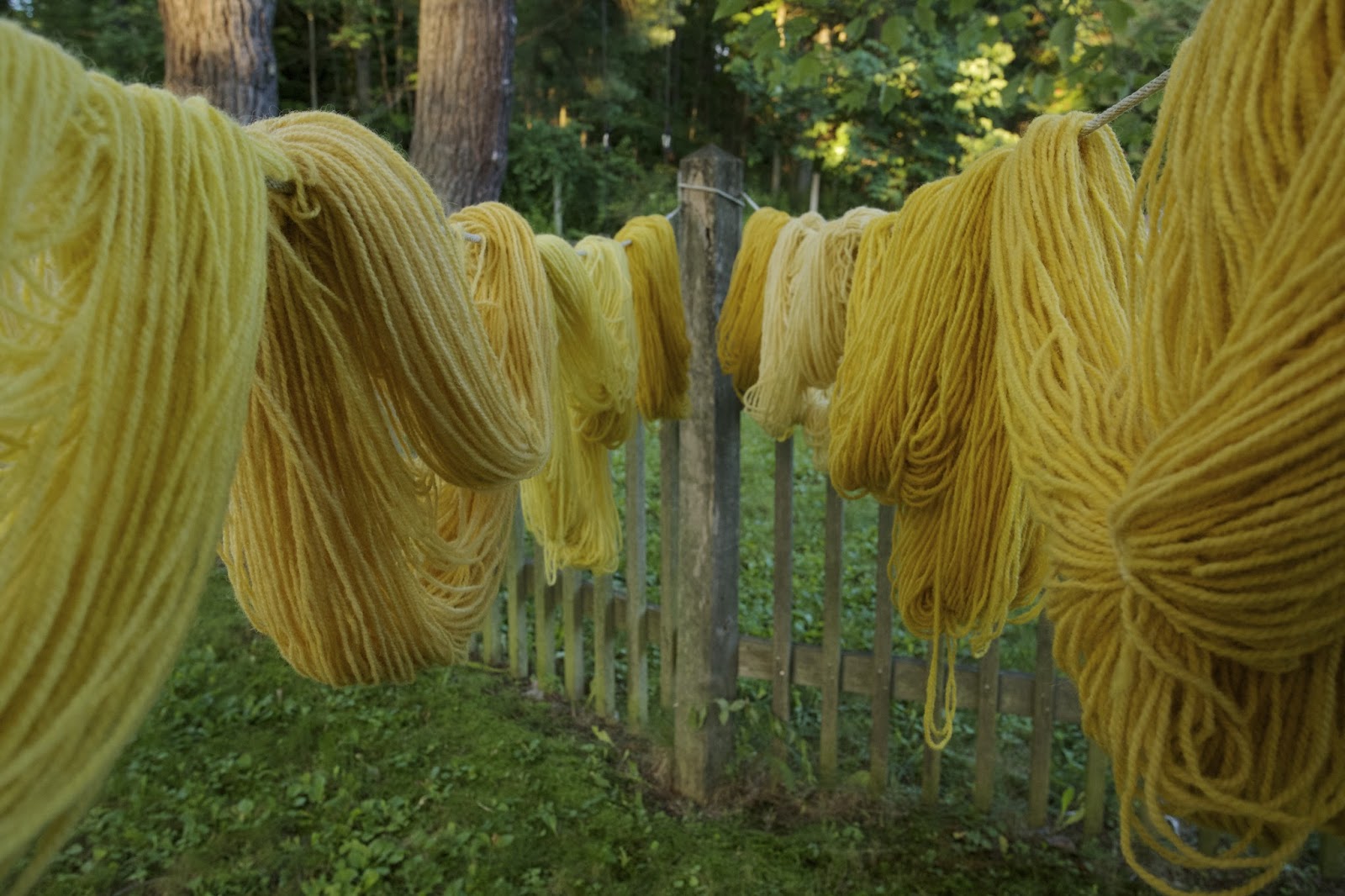
 Yarn drying after the mordant process so I could store it before I used it.  There was a lot of yarn this year - almost double and I'm not done yet - just a few more over-dyeing to go.  


 I really love my yard


 I found many great oranges this year.  As always its so much fun to lay out the rainbow of colors and photograph them.  I will get them all out soon let you see.

 Onion Skins, tansy, goldenrod, osage orange all used one at a time but in the same pot so by the end it was all mixed up.

Madder and cochineal

Friday, May 8, 2015

Bloodroot Plant Dye


I have been dyeing a long time now and I am still finding new to-me dyes that are exciting.  Bloodroot is the new one for me this Spring.  Its an old Native American dye and has been used for centuries.  
What took me so long?  Its orange - bright beautiful orange.


The rhizomes are ugly and quite frankly they look like bugs lying on the counter.  The leafs are up right now and have a white flower that is just about to die out if they haven't already.  You can find them on a shady road sides & in the shadows of the woods (please be responsible if you dig them up). They are easy to dig as the rhizomes are shallow. 


I diced the fresh rhizomes up and warmed up the pot to just below boil. 
 I also have a few drying and I am also putting this jar in the sun to see if a slow cool seep changes the color.


 The upper left corner is after dipped in washing soda and I didn't see a strong color change in the wool.  The silk however you can see a change in the top part (washing soda) a more yellow orange, the bottom is just out of the pot.  I plan to do a light test next to see the color fastness but I have high hopes given the history.

Monday, May 4, 2015

Plant Dyeing Workshop


I have finally taught a 'proper' workshop on plant dyeing.  I have had many dyeing sessions with friend, and at work, but this one was the first attempt at an organized event.  Thank you Craftstitute for creating space here in Ithaca where artists can come and have a space to teach a class.   I think it went off very well and I hope my - newly addicted to color friends - agree.


We started off by putting plastic labels on the skeins, then pre-soaking the fibers in water.  I had already mordanted the skeins prior to class in Alum & Cream of Tartar.  After adding the dye stuff which was - Sage brush ( I collected some branches when I went out west a few years ago), dried Marigold flower heads, Red Onion skins, Madder and then a lichen I had soaking in an ammonia bath for a month - after about 45 minutes of hot soaking we then strained the bath thru mesh and cheesecloth.


The marigold turned out to be a really strong yellow and everybody loved it.


The red onion skin didn't turn out a greenish as it had in the past.  Its a wonder to get get color from nature and its always a surprise.


The madder had been soaking in my kitchen for days and the red (on the orange side) that we got was very impressive.


Stunning results - thank you nature.

Wednesday, September 3, 2014

Lovely Goldenrod Flowers


I swoon every time late August arrives because it signals the return of my favorite plant dye flower.
The Goldenrod
The yellow it gives in fields and dye pots is by far my favorite.  I thought I would lay out a few mordant and after dip combinations I have done.  There isn't much a difference in yellows - the ammonia after dip warms it up considerably - but the iron after dip is quite significant.  There is a difference in color depending on the wool/yarn you choose.  Its always important to do your own tests.  When you do your tests make sure you use to correct per portion of dye to weight of yarn.  If you make up your "full" dye pot but dip in test yarns remember that the tests will produce a darker color than if you had put in your full amount of yarn.  


When I make a pot of goldenrod dye I fill my pot full of blossom tips.  The tips are fresh and barely open.  The older the flower the saddened the color will be, but if your going to add iron anyway to get that great green it would be fine.  Plus in November and the last flowers are blooming I grab them anyway.  I have two frozen bags of fresh flowers in the freezer and plan on using them this winter - I'll post the results here in an update to see if they produce anything different.  


I have over dyed goldenrod and indigo and receive the most gorgeous greens you ever have seen.  I also have a great time achieving oranges with cochineal.  Ill try to post that next.

Remember its not the lovely goldenrod that is making you sneeze but the ragweed that grows next to it - so marvel in the beauty of goldenrod and enjoy its splendor of color.


I am also happy to report that I am once again the Handwork Teacher for the Ithaca Waldorf School in Ithaca,  NY.  I start tomorrow and I will hopefully take up this blog to track my comings and goings of teaching this year and future years.


Sunday, July 20, 2014

Natural Dye Chart


I have been doing a  lot of Natural Dyeing this summer already.  These are some samples I kept.  If you have any questions let me know.  Different wools (breeds and there for yarns) soak up the dye differently.